Payroll migration, built around who's going to run it.
Two ways onto Affinity: guided, where your team stays hands-on and builds the capability to run it themselves, or fully managed, where we take it end-to-end. Both are fixed-price, designed with you before you sign, and proven with parallel runs before go-live.
In short: Affinity's payroll migration services cover the full switch onto our platform – two implementation paths (guided for SaaS and Supported, fully managed for FMS), delivered on a fixed price scoped to your pay groups, employee numbers, T&A complexity, go-live phasing and number of databases. No open-ended consulting, no black box.
Switching payroll is where it can all go wrong.
A system change is disruptive and risky – and the implementation is what decides whether the next few years feel confident or shaky.
Real, external risk
Data migration errors, compliance gaps mid-cutover, open-ended consulting costs, and a go-live date that quietly slips.
It happens on your watch
The fear that the implementation goes wrong under your name – and that you end up sidelined, handed a system built by someone else that you don't fully control.
A black box you can't open
Changing payroll shouldn't mean handing control to a vendor. Whoever runs payroll should understand the system – not inherit one they were never shown.
We've guided AU & NZ businesses through this exact switch for 40+ years.
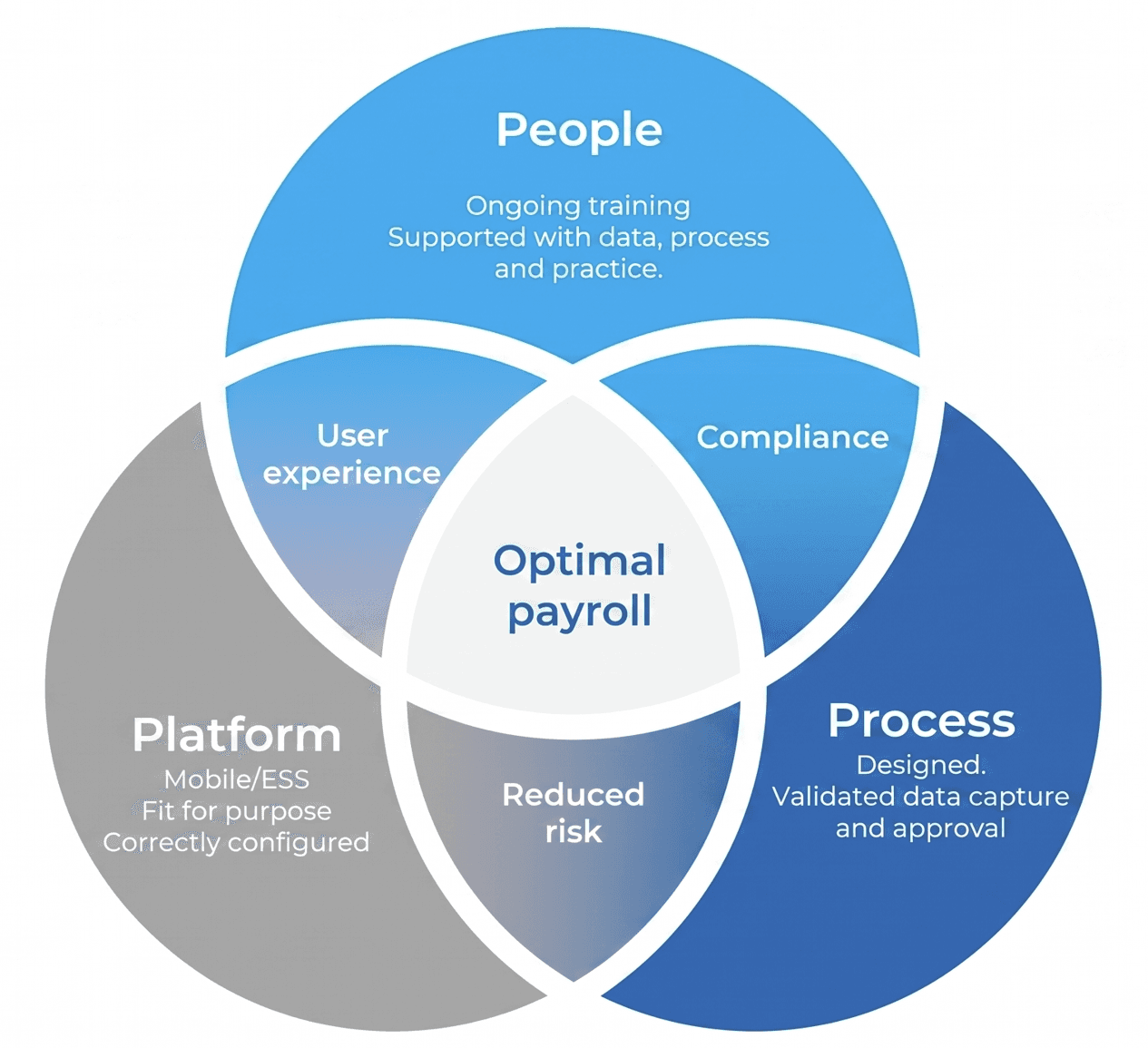
Changing payroll systems is genuinely hard, and we don't pretend otherwise. What makes it land safely is getting three things aligned – your people, the platform, and the process. That's the whole job.
Designed before you sign
A consultative Solution Design Document, built with you during the sales process, sets out the agreed build before you commit – so there's no black box, and the design stays version-controlled after sign-off.
Proven with parallel runs
Every payroll gets a minimum of two parallel pay runs, and we can run them over any period – so edge cases like public holidays around Easter or Christmas are caught and fixed before go-live, not on your first live pay.
A named, local team
One consistent team for the length of the project – solution consultant, lead payroll consultant, self-service SME, integration analyst and project manager. Local experts you'll know by name, not a rotating help desk.
A plan you can see from the start.
Three moves, one fixed price, and a methodology that's the same every time.
Design it together
A consultative Solution Design Document defines the agreed build before you sign – so there's no black box, and you own the design from day one.
Implement on a fixed price
We deliver through a defined five-stage methodology – Planning & Scope, Migration & Configuration and Testing, including parallel runs – with no surprises on cost.
Go live with confidence
Go live on the model that fits how you'll run payroll, backed by hypercare support after go-live and a team that already knows your setup.
The implementation journey
Five stages, the same disciplined path every time.
Project initiation & scoping
- Kick-off
- Discovery of your requirements
- Solution design confirmation
- Project timeline and milestones
- Finalised Statement of Work
- Agreed objectives
System configuration & data migration
- Configuration workshops
- Payroll & workforce management config
- Self-service, workflows, MyPA & forms
- General ledger & interface development
- Employee data migration
Acceptance
- Parallel processing – a minimum of two pay runs
- Run over any period to catch edge cases
- User acceptance testing
Go-live preparation & go-live
- Cutover planning
- Configuration tweaks
- Employee data imports
- First live pay run
- Release banking
Hypercare, optimisation & close
- Hypercare support & optimisation
- Project review
- Implementation sign-off
- Close
Indicative timing – most projects reach first go-live within 3–4 months. Larger or multi-entity projects run multiple staged go-lives over an extended timeframe.
Two paths, one principle
Whoever runs payroll day-to-day should be the one hands-on and building capability through implementation – so the path you take follows how you'll run payroll afterwards.
Guided
SaaS & Supported
Your team stays hands-on throughout, learning the system and building the capability to run it yourselves. We recommend the person who currently runs your payroll leads on your side – their business knowledge is what makes the switch land safely.
Fully Managed
FMS
We deliver the implementation end-to-end and run your payroll for you afterwards – the same disciplined methodology, with Affinity carrying the day-to-day load once you're live.
A fixed price, and you can see what drives it.
Implementation is quoted as a fixed price up front – not open-ended consulting. It's scoped to a handful of factors, so "no surprises" is a mechanism, not a slogan.
Pay groups
Employee numbers
T&A complexity
Go-live phasing
Number of databases
Ready to plan your move?
Tell us about your current setup and we'll walk you through what a guided or fully managed switch looks like for your business.
Get it wrong, and…
- A go-live that slips – or fails outright
- Open-ended costs that blow the budget
- Compliance exposure during the cutover window
- A team left dependent on the vendor
- Employee pay disruption and lost trust
Get it right, and…
- On-time go-live, with a fixed price held to
- A team that understands and can run their own system
- Smooth pay for employees from day one
- Compliance continuity through the switch
- Confidence heading into the next cycle, not just the first
Trusted by leading AU/NZ enterprises through their payroll switch
Frequently asked questions
What's the difference between Affinity's guided and fully managed implementation?
Guided (SaaS and Supported) keeps your team hands-on, building the capability to run the system yourselves. Fully Managed (FMS) is delivered end-to-end by Affinity.
How is implementation priced?
Fixed price, scoped to your pay groups, employee numbers, T&A complexity, go-live phasing and number of databases – agreed upfront so there are no surprises.
How long does implementation take?
Most projects reach first go-live within 3–4 months. Larger or multi-entity projects can involve multiple staged go-lives over an extended timeframe.
How do you make sure our first pay run is accurate?
Every implementation includes a minimum of two parallel pay runs, which can be run over any period – so edge cases like public holidays around Easter or Christmas are tested and resolved before you go live.
What is a Solution Design Document, and why do we complete one before signing?
It's the agreed functional design for your implementation, built collaboratively during the sales process so you see and sign off the integrated design before committing – not after.
Who from Affinity will we be working with?
A named, consistent team for the length of the project: a solution consultant, lead payroll consultant, self-service SME, integration analyst and project manager – all local experts, not a rotating help desk.
Who do we need to involve on our side?
A payroll SME – we recommend whoever currently runs your payroll, not a contractor, because their business knowledge is critical to a smooth switch – an HR SME for integration to your HR systems and process knowledge, and a technical/integration resource for interfaces.
What happens after go-live?
A hypercare and optimisation period, followed by a project review and formal implementation sign-off.
Planning a change?
Two free guides for the two decisions that come before a vendor conversation – whether the change is worth making, and how to judge who can make it.
Build a payroll business case that gets approved
Cost the status quo, value the change, and get to the payback, ROI and NPV a board actually decides on. Includes a savings estimator and a board-ready template.
Choosing a payroll provider
Define what you actually need before you compare a single vendor – then turn it into a scored brief every vendor answers. Includes an RFP template and weighted scoring tool.